
Tafraout
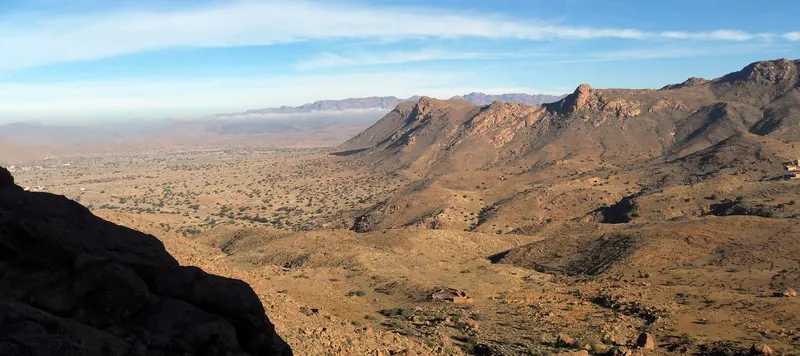
Pink granite, the villages of the Ammeln Valley and painted rocks: choose a focused Anti-Atlas stay around Tafraout.
In this guide
Overview: choose a base among the granite
Tafraout introduces a different mountain setting from the High Atlas: the pink granite landscapes and inhabited valleys of the Anti-Atlas. Make the town or a named village your base, then choose an outing that matches why you came. Looking at rock formations, visiting the Ammeln Valley and undertaking a mountain walk are different uses of a day. You can enjoy the setting without building the whole stay around a demanding trek.
Experiences: natural forms and painted rocks
South of Tafraout, the regional tourism council describes a pink granite landscape containing Jean Vérame’s painted rocks. Their applied colour makes an intentional artwork within the rocky setting. At Aguerd Oudad, another formation is known locally as Agadir N’Tfraout and to visitors as Napoleon’s Hat. Keep the village and the artwork distinct when arranging a visit: they are different stops. Ask about the current approach and viewing areas rather than assuming a photograph implies permission to climb.
Local context: the Ammeln Valley is inhabited
The Ammeln Valley runs beneath Jbel El Kest, with villages and cultivated trees including almonds, olives and palms. Its Ammeln Amazigh heritage belongs to the communities living there. Look at how homes, fields and the mountain edge relate to one another, and ask a guide to explain the particular village you visit. Permission to enter a home, garden or building should come from the people concerned, not from a general description of village hospitality.
Back to contentsPlan the day: valley north, painted rocks south
Choose a direction before collecting stops. The Ammeln Valley lies north of Tafraout; the regional tourism council identifies a traditional museum at Oumesnat for a possible cultural visit. Confirm that it is receiving visitors before making it the day’s anchor. Aguerd Oudad and the painted rocks lie to the south. For either outing, agree the start and finish, walking time, terrain and return transport. A village visit need not include an ascent of Jbel El Kest; match the route to your group and keep a shorter alternative.
Getting around: identify the final approach
Confirm whether your room is in Tafraout itself or a village in the surrounding area. Establish the arrival point, luggage transfer and options for meals before choosing between them. For an outing, agree which named places are included and whether the driver waits or returns later. Build the onward journey into the same plan: an attractive rural stay is easier to enjoy when departure arrangements are settled.
Next steps: one landscape at a time
Three nights would allow two full days between arrival and departure: one for the granite landscape and one for a chosen valley visit. Treat that as a starting allowance, with extra time for a specific walking programme. Compare Tafraout with Taroudant’s medina or Agadir’s coast before extending the route. Keep the transfer day free of a fixed outdoor activity until the connection and conditions are confirmed.
Back to contentsSources
Each reference lists the information it supports and the date it was checked.
- Agadir Souss-Massa Regional Tourism Council: the rocks of Tafraout
Pink granite south of Tafraout; Jean Vérame’s painted rocks; Aguerd Oudad and the formation called Agadir N’Tfraout, also known as Napoleon’s Hat. This source does not establish current access or permission to climb or camp.
Checked
- Agadir Souss-Massa Regional Tourism Council: Ammeln Valley
Anti-Atlas setting, valley at the foot of Jbel El Kest, villages, cultivated trees and Ammeln Amazigh heritage. No universal walking difficulty, seasonal guarantee or private-home access adopted.
Checked
- Agadir Souss-Massa Regional Tourism Council: discovery of the Tafraout land
Places the Ammeln Valley north of Tafraout and Aguerd Oudad and the painted rocks to the south; identifies a traditional museum at Oumesnat. Current museum opening, route conditions and walking suitability require separate confirmation.
Checked
Something needs attention? Read about corrections.
Back to the start of this guide